Showing posts with label Global Warming. Show all posts

Can Obama Make History on Immigration?


Can Obama Make History on Immigration? - This is actually happening. That’s the viewpoint of Capitol Hill aides, lobbyists, advocates, and politicians who have been involved in the immigration debate for 10, 20, and in some cases 30 years. They are psyched. They are scared. They are sober.

They miss the late Sen. Edward Kennedy, D-Mass., who has been at the forefront of every immigration law since 1965. They are grateful for Sen. Marco Rubio, R-Fla., who has spurred a new way of thinking about immigration among conservatives.

This account is based on interviews with more than a dozen people close to the immigration talks on Capitol Hill and in the White House.


President Obama’s speech on Tuesday in Nevada will mark the public unveiling of private planning that has been in the works at the White House and in Congress for at least a year. Administration officials have mulled every possible option for easing the paradox of too many illegal immigrants and a stilted legal system. The only real solution is broad legislation.

No one knows how it will end. The public statements from Obama and a group of bipartisan senators will reflect a possible resolution to years of conflict and confusion. The contours of the deal are so simple that a Martian visiting the United States would wonder why politicians have been fighting about it for 15 years. There will be some type of earned legalization for illegal immigrants, an ironclad way for employers to verify that their employees are legal, a smooth visa system for future immigrants, and robust border security.

Everyone with a stake in the outcome fears that a misstep on the part of one political party will offend the other party and blow up the deal. Two old hands at the debate, Sens. John McCain, R-Ariz., and Robert Menendez, D-N.J., were extremely careful on ABC's This Week on Sunday talking about immigration. McCain said he wanted Obama's help. Menendez said Obama would work with Republicans. Liberals fear that Obama will be too dictatorial when he spells out his immigration reform plan. If his tone isn’t deferential enough, it could alienate Republicans whose support is needed for anything to pass. Conservatives fear that Democrats don’t actually want an immigration reform bill and would rather make Republicans look bad by alienating Hispanics.

Whatever happens, it will play out in a big way. Senate Majority Leader Harry Reid has designated immigration legislation with the bill number S.1, a signal the bill is the top Senate priority. (He did the same thing for Obama’s health care bill.) The Senate Judiciary Committee is expected to begin crafting it in February. It should be on the Senate floor in May or June.

Lengthy congressional debates of this sort are public and messy. Drafters of the bill will have their hands full keeping the amendment process from sinking the effort. The White House will need to keep up the pressure without scaring away skittish Republicans. It’s a delicate dance that has never been attempted without Kennedy.

Advocates expect to lose at least five Democrats in the Senate, which means they will need upwards of a dozen Republicans to vote for the legislation. That’s where Rubio and other tea party favorites like Sen. Mike Lee of Utah will come into play. Rubio and Lee are newcomers to an old discussion among Republican veterans like McCain and Sen. Lindsey Graham of South Carolina. Newly elected Sen. Jeff Flake of Arizona will be a key Republican player as well.

Conservative senators who want an immigration bill will be pitted against fellow conservatives who don’t, like Sens. Charles Grassley of Iowa, Jeff Sessions of Alabama, and David Vitter of Louisiana. To get past their own party’s naysayers, Republicans could make demands that are unpleasant, if not unpalatable, for traditional Democrats.

Next comes the House, where Judiciary Committee Chairman Bob Goodlatte, R-Va., is in no hurry to rush any broad legislation. Goodlatte’s main objective is much more modest--to familiarize his committee members with immigration policy such that they understand the difference between a work visa and a green card. There are not enough Republican votes in the House to pass anything that would earn Obama’s signature or the nod from Senate Democrats.

So how can a sweeping immigration bill actually pass? Supporters from both parties are acutely aware that missteps in a few crucial areas could derail the effort. But they also sense a new political reality pushed into sharp relief by November’s election—the stalemate on immigration has to end. Republican strategists want nothing more than to remove the issue from their plates. The only way that happens is if a bill passes.

There are three main hurdles to passing an immigration bill—citizenship, guest-workers, and House Republicans. Any one of them could scuttle the prospects of passage, but all are surmountable.

Citizenship. 

A bizarre shift occurred in the last year when Rubio emerged onto the national scene and begged fellow conservatives to speak more positively about immigration. The sparring that used to be about “amnesty,” or legalizing illegal immigrants, is now about granting them citizenship. Rubio and former House Speaker Newt Gingrich are among the conservatives who have protested any law that gives illegal immigrants their own method of becoming citizens.

That’s fine, say White House officials and congressional Democrats. They aren’t asking for a special path to citizenship. They just want it to be possible for non-criminal undocumented immigrants to live legally in the United States and use regular methods to become citizens within a reasonable amount of time. “Reasonable” is subject to negotiation—10 years? 20 years? No one disputes that the illegal immigrants need to be “at the back of the line.” The negotiation is basically a matter of logistics unless Republicans refuse to allow any way for illegal immigrants to become citizens. Then it’s over.

Guest-workers. 

Conservatives are worried that unions will sink the immigration deal by flatly opposing any bill that has a guest-worker component. Democrats and unions are wary of guest-worker programs because they fear that Americans will lose out on job opportunities and working conditions will slide. In the past, the business community and Republicans have insisted that any comprehensive immigration fix include guest-worker visas.

The weak economy has made this conversation easier. “Guest-worker” is a dirty word in business circles. It has now in vogue to talk about permanent green cards for skilled foreign workers, a topic far less inflammatory for unions. There is a dedicated consortium of influential employers who are willing to throw serious lobbying heft behind more green cards for foreign engineers and scientists. Obama and the bipartisan group of senators will probably make a big deal about the need for skilled workers at first and save the trickier question of temporary visas for low-skilled employees for a smaller stage. (Like, say, at the end of a 12-hour markup in committee.)

House Republicans. 

No one expects “regular order” in the House on immigration. Any broad bill that comes to the floor under normal proceedings would certainly be doomed. The House has killed Senate immigration legislation before (in 2006), and forces are gathering to do so again. The Judiciary Committee counts several bomb throwers as members; Rep. Steve King, R-Iowa, is the most well known in immigration circles. The committee also includes ruby-red conservatives like Rep. Jim Jordan, R-Ohio, whose actions are closely scrutinized by other Republicans. Its former chairman, Rep. Lamar Smith, R-Texas, is feverishly opposed to increasing immigration, particularly for low-skilled workers.

But that doesn’t mean an immigration bill can’t get through. A bipartisan group of House lawmakers has been quietly working on an immigration bill that would satisfy conservatives and liberals. The Republican participants are a closely-held secret, but whisperers say they include serious conservatives like Reps. Paul Ryan of Wisconsin, Ted Poe of Texas, and Raul Labrador of Idaho. House Speaker John Boehner is among the Republicans who desperately want the GOP’s hand-wringing on immigration to end. He has already demonstrated that he is willing to flout party rabble-rousers with the House's recent votes on fiscal cliff taxes and Hurricane Sandy, which passed with more Democrats than Republicans.

Boehner has to be careful. He only has so many chances to put incendiary legislation on the floor before his caucus stages an all-out revolt. To appease them, he will probably offer one or two high-profile House votes, where Democrats will protest like crazy, on enforcement-only immigration legislation. That gets the dealmakers to the next step, a conference committee where anything can happen. As Kennedy was fond of saying, "We'll fix it in conference."

If Boehner wants the issue to go away, he might be willing to put a conference report up for a vote despite a raucous caucus. It's possible that enough Republicans could join with Democrats to support it. ( National Journal )

READ MORE - Can Obama Make History on Immigration?

Obama faces familiar world of problems in 2nd term


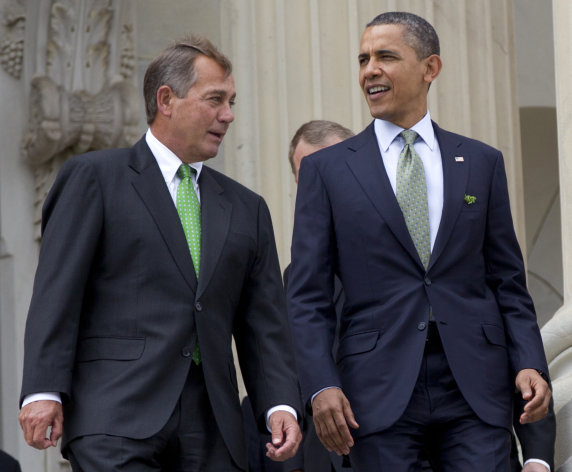
FILE - This March 20, 2012 file photo shows House Speaker John Boehner of Ohio and President Barack Obama walk down the steps of the Capitol in Washington. The people of an intensely divided nation just created a government that looks the same way as the one before. The only hope for progress on creating jobs and everything else would be if Obama and Republicans in Congress could find some incentive to compromise. (AP Photo/Carolyn Kaster, File)

Obama faces familiar world of problems in 2nd term — Now that his re-election is secured, President Barack Obama has a freer hand to deal with a world of familiar problems in fresh ways, from toughening America's approach to Iran and Syria while potentially engaging other repressive countries such as Cuba and North Korea and refocusing on moribund Middle East peace efforts.

The first tweaks in his Iran policy could come within weeks, officials said.

But a pressing task for Obama will be to assign a new team to carry out his national security agenda. Secretary of State Hillary Rodham Clinton has announced her plans to retire but could stay a few weeks past January to help the administration as it reshuffles personnel. Defense Secretary Leon Panetta is likely to depart shortly after her. CIA Director Gen. David Petraeus is expected to stay on.

The favorite to succeed Clinton, U.N. Ambassador Susan Rice, would face a difficult Senate confirmation process after her much-maligned explanations of the attack on the U.S. Consulate in Benghazi, Libya, meaning she could land instead as Obama's national security adviser. That job that doesn't require the Senate's approval. Tom Donilon, who currently holds that position, and Chuck Hagel, a former Republican senator, are among the other contenders.

The chances of another early favorite, Senate Foreign Relations Committee Chairman John Kerry, are hampered by Democrats' fear that Republican Scott Brown, who lost his Massachusetts Senate seat Tuesday, could win Kerry's seat in a race to replace him.

Officials, however, are pointing to Jon Huntsman, the former Utah governor, Obama's ambassador to China and Republican presidential candidate, and the State Department's current No. 2, William Burns.

Huntsman is still widely respected by the administration even if he'd hoped to unseat Obama. Choosing Huntsman would allow the president to claim bipartisanship while putting an Asia expert in the job at a time when the U.S. is focusing more attention on the world's most populous continent. Burns would be an option as caretaker secretary until postelection passions in Congress subside and a permanent replacement might face smoother confirmation. He is a career diplomat who has no political baggage and would be unlikely to stir significant opposition among lawmakers.

At the Pentagon, speculation about successors has been limited. Panetta's deputy, Ashton Carter, is seen as a possibility, along with Michele Flournoy, who served as Defense Department policy chief from 2009-12 and would be the first woman in the top job.

New Cabinet members will enter at a time of various global security challenges, from the Arab Spring to China's rapid economic and military expansion in Asia. But the president's escape from any future campaigning also offers unique diplomatic opportunities, which Obama himself hinted at in March when he told then-Russian president and current prime minister Dmitry Medvedev that he'd have "more flexibility" on thorny issues after the election.

Obama's immediate predecessors, Bill Clinton and George W. Bush, used their second terms to launch major, though ultimately unsuccessful initiatives for an Israeli-Palestinian accord, an elusive goal that Obama also deeply desires. This summer he listed the lack of progress toward peace among the biggest disappointments of his presidency so far, suggesting another U.S. attempt in the offing.

Clinton's Camp David negotiations and Bush's Annapolis process became signature foreign policy priorities in 2000 and 2007. But the Israelis and the Palestinians remain as far apart as ever on the contours of an agreement, from the borders of their two separate states to issues related to refugees and resources.

Any Obama-led plan for the Middle East will be complicated by Israel's fears about the Iranian nuclear program, civil war in nearby Syria and the new reality of an Islamist-led Egypt having replaced America's most faithful Arab ally. Obama's difficult relationship with Israeli Prime Minister Benjamin Netanyahu could also complicate the process.

With Iran, the president is holding out hope that crippling economic sanctions will force the Islamic republic's leaders to scale back its uranium enrichment activity. Iran insists its program is designed for energy and medical research purposes, even as many in the West fear the ultimate goal is to produce nuclear weapons. Obama has stressed the narrowing time frame for Tehran to negotiate a peaceful solution to the standoff, while pressing Israel to hold off on any plans for a pre-emptive strike.

Officials say the administration is likely to adjust its two-track approach to Iran — which offers Tehran rewards for coming clean on its nuclear program and harsher penalties for continued defiance — in the coming weeks. Details are still being debated. In the end, however, Obama may have to resort to a military strategy if Iran continues to enrich uranium at higher levels and nears production of weapons-grade material — a possible scenario he acknowledges.

"The clock is ticking. We're not going to allow Iran to perpetually engage in negotiations that lead nowhere," Obama said in his last foreign policy debate with Republican presidential candidate Mitt Romney. "We have a sense of when they would get breakout capacity, which means that we would not be able to intervene in time to stop their nuclear program."

Syria's widening conflict is another concern. More than 36,000 people have died in the last 20 months, as a brutal crackdown on dissent by President Bashar Assad's regime has descended into a full-scale civil war. Obama has demanded Assad's departure, yet has ruled out military assistance to the rebels or American military actions such as airstrikes or enforcing a no-fly zone over Syria.

Last week, in a significant shift in policy, the secretary of state demanded a major shakeup in the opposition's ranks in the hopes of rallying Syrians behind the rebellion. However, Clinton's spokeswoman, Victoria Nuland, reiterated Wednesday the administration still rejects the notion of providing weapons to anti-Assad fighters or any talk of armed intervention.

In other places, Obama's engagement efforts may get another look. After some success with a rapidly liberalizing Myanmar, there are hopes for democratic reforms and human rights advances in Cuba and North Korea, among others.

But short of a rapid change in attitude from these governments, Obama's options for a landmark breakthrough in U.S. diplomacy are limited. He won't be able to reach out to Havana until it frees the jailed U.S. contractor Alan Gross, while Pyongyang will have to denuclearize if it wants better relations with America — steps neither regime has shown a willingness to entertain. The recent re-election of Venezuelan President Hugo Chavez has halted chances for now of any rapprochement between Washington and Caracas.

In Afghanistan, the president will seek to stick to NATO's 2014 withdrawal date for most international troops, a central campaign promise. His administration has been trying unsuccessfully to jump-start peace negotiations between President Hamid Karzai's Western-backed government and the Taliban. The so-called reconciliation effort relies heavily on America's frustrating and unreliable ally Pakistan, where extremist groups such as al-Qaida and the Haqqani network will continue to face U.S. drone attacks.

Behind all the diplomatic efforts are larger questions of American geopolitical strategy. Obama had initial success improving U.S. relations with Russia, getting a nuclear arms-reduction pact in 2011, but has since seen America's former Cold War foe frustrate U.S. missile defense plans and hopes of an international consensus on Syria. The president has continued to trumpet the benefits of his Russia "reset" policy but may take a firmer stance against Moscow if it refuses to show compromise.

For economic reasons, China policy is less likely to change. The world's two biggest economies are deeply interdependent and, despite lingering disagreements over Beijing's currency exchange rates and intellectual property infringement, neither side will want to do anything that threatens a trade war and jeopardizes China's booming growth or America's still-fragile jobs recovery. ( Associated Press )

READ MORE - Obama faces familiar world of problems in 2nd term

We will lead on climate change


We will lead on climate change - New York must press ahead with urgency to equip itself for the new age of extreme weather


A mailbox sits on the porch of a burned out home in the Breezy Point section of Queens.

In just 22 months as governor, I’ve witnessed firsthand the destructive force of three powerful storms that have crippled the state: Irene, Lee and now Sandy.

Each has taken an immeasurable toll on communities. Precious lives have been lost, and homes and businesses destroyed. This storm alone was responsible for 60 deaths to date and more than $30 billion in damage in New York State.

Extreme weather is the new normal. In the past two years, we have had two storms, each with the odds of a 100-year occurrence. Debating why does not lead to solutions — it leads to gridlock. The denial and deliberation from extremists on both sides about the causes of climate change are distracting us from addressing its inarguable effects. Recent events demand that we get serious once and for all.

We need to act, not simply react.

First, we must begin by thinking about where and how we rebuild. The next generation’s infrastructure must be able to withstand another storm. We must also reduce the energy consumption that contributes to climate change — which means, for starters, upgrading our building codes.

Thinking carefully about where we locate critical pieces of our infrastructure networks will avoid a disaster domino effect, such as the explosion of the Con Ed substation that knocked out power to much of lower Manhattan.

Second, we must fortify and upgrade the systems that paralyze us when they fail. That means building redundancies into our fuel system and putting in place generators and pumping systems that are readily deployable. Actions such as these will avoid panic at the pump, lengthy lines and frustrated motorists.


sandy and cuomo
Gov. Andrew Cuomo inspects a deluge of water flooding the Battery Tunnel in Manhattan as Hurricane Sandy made its approach in New York.

Mass transit is the lifeblood of New York, and a 21st century city must protect and improve its mass transit infrastructure. Subways and tunnels are clearly vulnerable to major flooding that can bring us to a standstill. We must diversify transit options so that if one system is temporarily disabled, commuters are not stranded at work or stuck at home.

Similarly, cell phone networks and other communications systems must be strengthened to ensure that first responders and citizens never lose the ability to communicate fully and instantly. The power outage knocked out service in the hardest-hit areas and rendered service elsewhere spotty at best.

Our electrical power grid and the structures that control it must undergo a fundamental redesign. Power utilities are the equivalent of vinyl records in the age of the iPod: antiquated, 1950s-style institutions that don’t serve our current needs.


Sandy
New York City firefighters look at the wreckage of several boats washed ashore by Hurricane Sandy in the Great Kills community of Staten Island.

The electrical system is particularly vulnerable. Entire above-ground wire networks in heavily wooded areas spell disaster in virtually every storm, yet nothing is being done to rectify this obvious vulnerability. To a large degree, the state and local governments are captive to the utilities in an emergency, just like their customers.

Six utilities do not compete for customers, but in a natural disaster they must compete against one another for scarce materials and personnel. We must investigate the weaknesses in the system and reform it to ensure that customers do not face catastrophic power losses every few years.

Finally, common sense demands reforming for the way we do business to protect against the impact of disasters. For example, we need a better system to track patients in health-care facilities and vulnerable people in the community so first responders know immediately who may need help.

Recent experiences also underscore the need for an improved cybersecurity monitoring operation, a well-trained army of people who can step in and help protect and rebuild vital systems without delay.

Sandy
Volunteers deliver blankets to Staten Island residents affected by Hurricane Sandy.

There is no more time for debate. This is our moment to act. On Thursday, I am announcing the formation of three commissions to look at key components of managing a new, better prepared New York: how we get ready before an event, how we respond in its immediate aftermath and what changes we can make to our infrastructure that will better prepare us to face Mother Nature’s inevitable fury.

New York has a natural advantage in this seemingly daunting task. We begin with an extraordinary enterprising spirit, unparalleled resiliency and a long history of engineering the impossible.

We are the state that built the Erie Canal, opening up commerce to the West. We built a subway system so extensive that its 800 miles of track could run from New York all the way to Chicago.

Time and again, we pushed boundaries and broke records. We have been tested before, and we have always risen to the challenge. We will not allow the national paralysis over climate change to stop us from pursuing the necessary path for the future. ( nydailynews.com )

READ MORE - We will lead on climate change